Written by Jose Luiz Soriano
Published: 10/12/2024
Reviewed by Innovation House Team

Organ on a Chip?
Yes you heard that right! Scientists from Harvard University discovered these chips and are using them to revolutionize the drug testing industry.
Organ-on-a-Chip (OoC) devices are multi-channel, 3D cell structures that simulate the mechanics of an entire organ or an organ system.
In the early 2000s, Dan Huh and Shuichi Takayama were testing whether they could simulate fluid accumulation (which occurs in diseased lungs), in an in vitro model. Soon after, they created the first OoC system designed to mimic the airways of the lung. Dr. Takayama displayed his device in a presentation at Harvard which sparked the interest of someone in the audience, a man named Donald Ingber. Donald Ingber, M.D., Sc.D., from the Wyss Institute at Harvard was amazed to hear a "crackle" sound from Dr. Takayama's device, a crackle similar to what he had learned to listen for to identify fluid in the lungs. This phenomenon had remained poorly understood due to the lack of lungs available for research. Dr. Ingber brought Huh to his lab and their team started work on the lung cell. Around 2010, they had created the first Organ-on-a-Chip.
"Following this success, Ingber and his team used funding from the Defense Advanced Research Projects Agency (DARPA), the Food and Drug Administration (FDA), and the National Institutes of Health (NIH) to develop more than 15 Organ-on-a-Chip models, including ones for the intestine, kidney, skin, bone marrow, and the blood-brain barrier. In 2014, Ingber founded Emulate to commercialize Organ-on-a-Chip technology."-emulatebio.com, "What are Organ-Chips?"
How do the chips work?
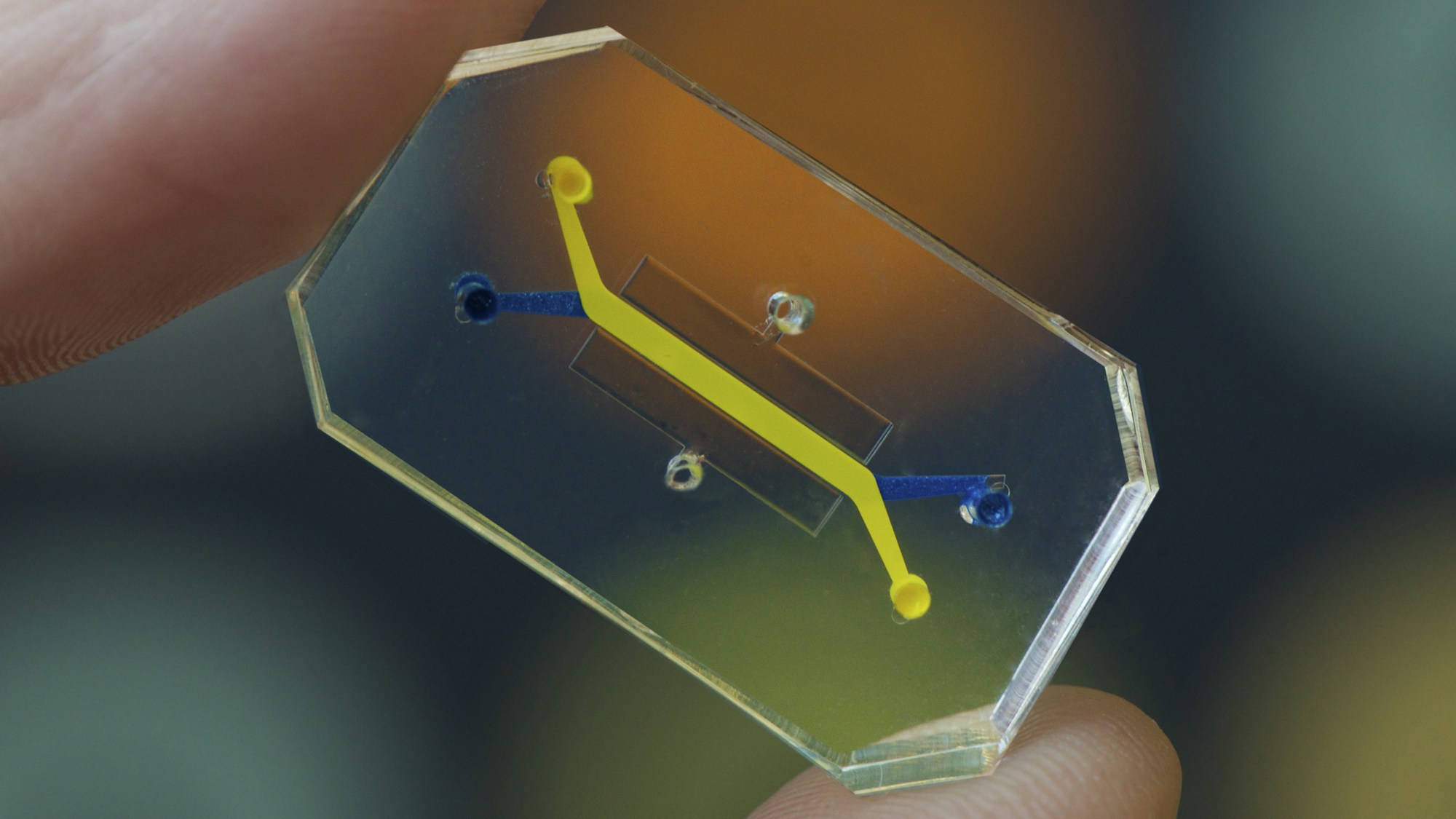
The Lung-on-a-Chip is around the size of a USB stick and has 3 main tubes. 2 vacuum channels, and a cell tube. The vacuums expand and contract to simulate lung breathing. In the center of the cell tube, a porous, polymer-like membrane separates the tube horizontally. On one side is the capillary cells, and the other is the lung cells. Blood is pumped into the capillary side, while air and bacteria are pumped into the lung side. This mimics the way our lungs fight off bacteria and other diseases. White blood cells go through the porous membrane via holes and attack the bacteria. Scientists pump drugs and medications into these tubes to see whether or not they are safe and effective for human use. There are also many different types of chips. Gut-on-a-Chip, Liver-on-a-Chip, Bone-on-a-Chip, Heart-on-a-Chip, and much more. All of these chips can be hooked together by tubes and form something called "Human Organs-on-chips".
How does this benefit us?
As you may know, when scientists want to test a drug, they usually test on animals before humans to make sure that the drug is safe. Over 115 million animals are tested on every year. However, the FDA no longer requires animal tests before human trials, which led to the use of organ-chips. Fortunately, these chips are more effective and accurate than animal testing. 27 drugs that passed animal testing, unfortunately, were toxic to humans. Researchers pumped these drugs into chips, and the chips flagged 87% of drugs that caused toxicity in the liver! These chips eliminate the need to potentially harm animals, and improve tests for humans. These chips also replace the need for organ donation for testing since they replicate human organs.
Organ-on-a-Chip technology is a 3-d cell culture to simulate organs in the human body. These chips eliminate the need for animal testing, and improve the accuracy of drug testing for humans.

An image of an Organ-Chip.


A diagram of how White Blood cells attack bacteria via a porous membrane.
References
Information:
Wells, J. (2024, February 9). What are Organ-Chips? Emulate. https://emulatebio.com/an-introduction-to-organ-on-a-chip-technology/
Human Organs-on-Chips. (2024, August 12). Wyss Institute. https://wyss.harvard.edu/technology/human-organs-on-chips/
Wikipedia contributors. (2024, September 20). Organ-on-a-chip. Wikipedia. https://en.wikipedia.org/wiki/Organ-on-a-chip
Leung, C. M., De Haan, P., Ronaldson-Bouchard, K., Kim, G., Ko, J., Rho, H. S., Chen, Z., Habibovic, P., Jeon, N. L., Takayama, S., Shuler, M. L., Vunjak-Novakovic, G., Frey, O., Verpoorte, E., & Toh, Y. (2022). A guide to the organ-on-a-chip. Nature Reviews Methods Primers, 2(1). https://doi.org/10.1038/s43586-022-00118-6
Images:
Human Organs-on-Chips. (2024, August 12). Wyss Institute. https://wyss.harvard.edu/technology/human-organs-on-chips/
Author's note:
Dear viewer,
Thank you for viewing our FIRST EVER BLOG POST at Innovation House! We will be publishing many more blogs in the future and feel free to give feedback and suggestions for us!
-Innovation House Team ;)
Add comment
Comments
Amazing!
...WOW!